
Buy a generic puppy starter bundle for a Yorkshire Terrier and you will end up returning about half of it.
The collar will be too wide for a four-inch neck. The crate will be sized for a dog four times the adult weight. The brush will be the wrong type entirely for a coat that grows like human hair rather than shedding on a cycle. The food kibble will be too large for a mouth that small to pick up comfortably.
A proper yorkie puppy checklist accounts for all of that. Yorkies are not simply small dogs, they are a breed with a specific coat type, specific joint considerations, specific dental tendencies, and an adult weight most people overestimate by a factor of two. Four to seven pounds is the standard. Not fifteen.
This checklist is organized by what you need before the puppy arrives, what to buy in the first month, and what you can genuinely skip. Prices are approximate and reflect what is realistic in the Houston area.
Before the Puppy Comes Home
Nine items. These need to be in the house, not in a shopping cart.
The Crate: Smaller Than You Think
Buy a crate sized 18 to 24 inches long. That is it. An adult Yorkie at six pounds needs enough room to stand, turn around and lie down fully stretched, and nothing more.
The temptation is to buy bigger because bigger seems kinder. It is the opposite. A puppy in an oversized crate designates one end as a bed and the other as a bathroom, which undermines the entire reason crate training works. If you buy a larger crate because you already have one, use the divider panel to shrink the usable space.
Wire crates with a plastic tray work well and run $35 to $55 at this size. A soft-sided carrier is a separate purchase and serves a different purpose, which is travel rather than home containment.
Harness, Not Collar, for Walks
This is the most important item on the list and the one most often bought wrong.
Yorkies are among the breeds most prone to tracheal collapse, a condition where the cartilage rings supporting the windpipe weaken. Pressure from a collar on a Yorkie’s throat, especially the repeated pressure of a dog pulling against a leash, is a genuine contributing factor rather than an abstract concern.
Buy a step-in or vest-style harness that distributes pressure across the chest. Avoid anything that tightens, and avoid thin strap harnesses that concentrate pressure in narrow lines. Expect $18 to $30.
A flat collar still belongs on your Yorkie, but only to carry an ID tag. Never attach a leash to it. Buy the narrowest collar you can find, half an inch or less, in the extra-small size, and check the fit weekly as the puppy grows.
The Right Bowls and the Right Food
Shallow, wide, low bowls. Stainless steel. A deep bowl requires a Yorkie to put their whole face in, which is uncomfortable and, for a long-coated breed, means a wet and food-caked chin.
Food needs to be a small-breed puppy formula specifically. The kibble size matters: standard puppy kibble is physically difficult for a Yorkie puppy to pick up and chew. Small-breed formulas also run higher in calories per cup, which matters because a tiny dog has a fast metabolism and a very small stomach.
The more serious reason to use a small-breed formula is blood sugar. Toy breed puppies, Yorkies especially, are prone to hypoglycemia in the first few months because they have almost no fat reserves. This is why Yorkie puppies need to eat three to four small meals a day rather than two, and why you should never let a young Yorkie go more than five or six hours without food. Ask what your puppy has been eating and keep it the same for the first two weeks.
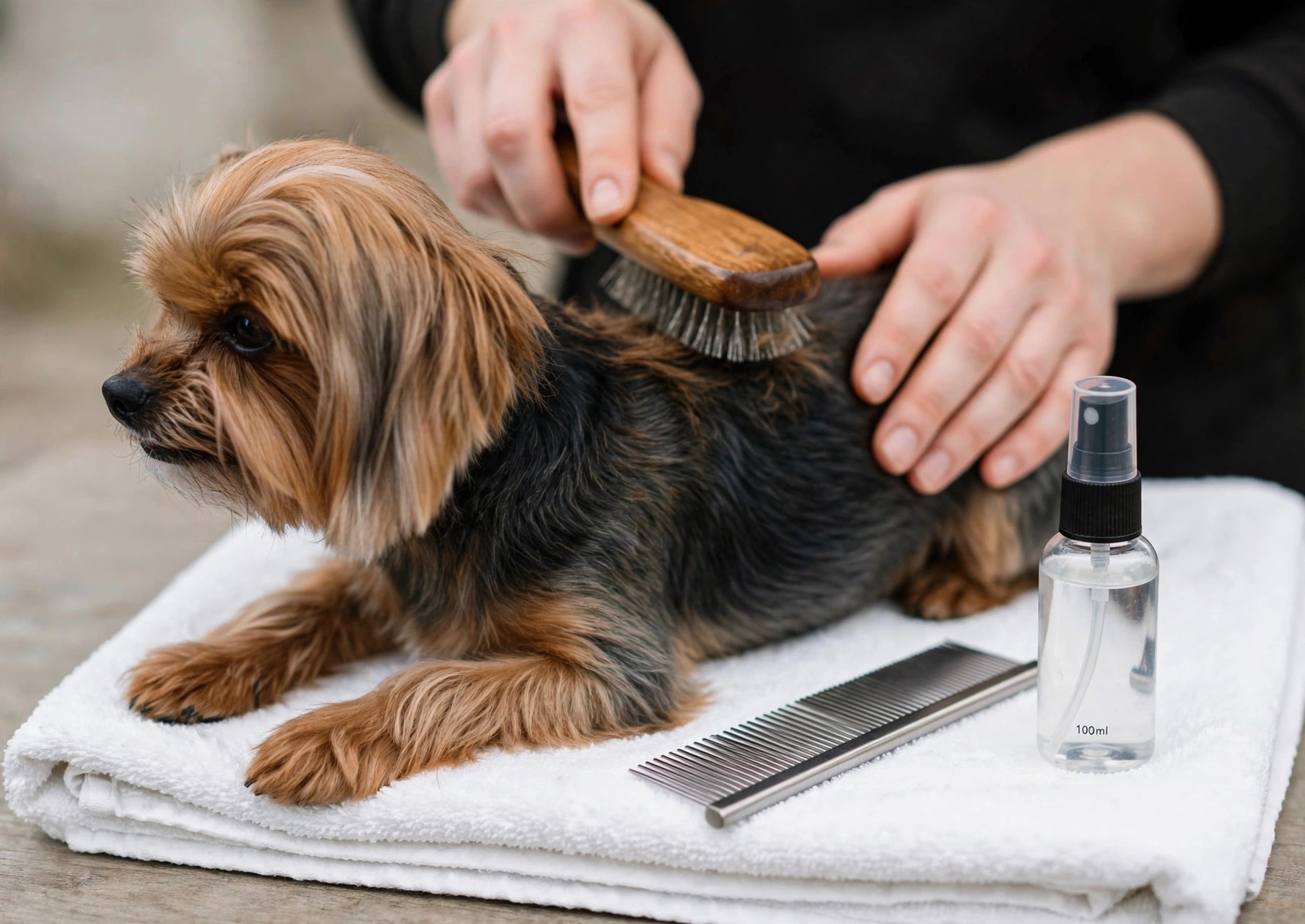
Grooming Tools: The Non-Negotiable Four
A Yorkie’s coat is genuinely different from most breeds. It grows continuously, it has a single layer rather than a double coat, and the texture is closer to human hair than to typical dog fur. It does not shed out, which means loose hair stays in the coat and mats.
You need:
- A pin brush with coated tips for daily brushing, $12 to $18
- A metal greyhound comb for finding mats the brush glides over, $10 to $15
- A detangling spray or leave-in conditioner, $10. Brushing a dry Yorkie coat causes breakage; lightly misting first does not.
- Small blunt-nosed scissors for trimming around eyes and paw pads, $12
Daily brushing is the standard for a Yorkie in a long coat. Every other day is the absolute minimum. Mats in this breed form close to the skin, tighten fast, and in Houston humidity can cause real irritation underneath.
If you plan to keep your Yorkie in a short puppy cut, which many Houston owners sensibly do, brushing drops to two or three times a week. You still need all four tools.
Cleanup and Potty Supplies
An enzymatic cleaner, not a regular household cleaner. Standard cleaners remove the visible mess but leave scent compounds a dog detects, marking the spot as an approved bathroom. Budget $15 for a gallon.
Potty pads or a potty-training grass pad are worth considering for a Yorkie in Houston specifically. From June through September, taking a four-pound puppy out onto hot pavement multiple times an hour is impractical and the surface temperature is genuinely unsafe. Many Yorkie owners here run an indoor option year-round and an outdoor one in the cooler months.
Toys Sized for a Small Mouth
Three or four toys, all small enough for a Yorkie to carry and soft enough for a small jaw. Avoid hard nylon chews and large rubber toys, which are too dense for a toy breed’s teeth. Avoid anything with small detachable parts.
Yorkies are terriers and they want to shake, carry and kill things. Small plush toys with squeakers and small rope toys suit the breed’s instincts far better than a hard chew will. $20 to $30 covers a reasonable starter set.
The First Month
Items worth buying once your puppy has settled and you know their size and habits.
A soft travel carrier, $30 to $50. Yorkies travel well and a carrier makes them portable in a way a larger dog is not. Choose one with a rigid base and good ventilation.
Pet stairs or a ramp, $30 to $60. A Yorkie jumping off a sofa is dropping four times their own height. Patellar luxation, where the kneecap slips out of position, is a known issue in the breed, and repeated high-impact landings do not help. This matters more than it sounds.
A dental kit, $15. Yorkies have significant dental crowding because the breed retains a full set of teeth in a very small jaw. Plaque accumulates fast and dental disease is one of the most common health problems in the breed. Start brushing in week two, when the puppy is settled, using a finger brush and dog-specific toothpaste. A Yorkie who accepts tooth brushing at three months will accept it at three years.
Non-slip runners, $25 to $50. Houston homes are mostly tile, and a Yorkie puppy scrambling on polished tile has no traction. Lay runners on the routes the puppy uses most.
A snuffle mat or lick mat, $18. Yorkies are smart, curious and prone to barking when bored. Food-based enrichment is the cheapest solution to a barky terrier.
A lightweight coat, $20. Houston does get cold snaps, and a Yorkie in a short cut with a single-layer coat and four pounds of body mass genuinely feels forty degrees. Needed in January, not July.
What Fits a Yorkie Versus What Does Not
| Item | What works for a Yorkie | What to avoid |
| Crate | 18 to 24 inches | Anything 30 inches or larger |
| Walking gear | Step-in or vest harness | Collar leash attachment, choke or prong |
| Collar | Half-inch or narrower, XS, ID tag only | Wide collars, anything over 1 inch |
| Bowls | Shallow, wide, stainless | Deep bowls, elevated stands |
| Food | Small-breed puppy formula, small kibble | Standard or large-breed kibble |
| Meals | 3 to 4 small meals daily | Two large meals |
| Brush | Pin brush plus metal comb | Slicker only, rubber curry brush |
| Chews | Soft rope, small plush, soft rubber | Hard nylon, antlers, large bones |
| Furniture access | Pet stairs or ramp | Letting them jump freely |
| Flooring | Non-slip runners on main routes | Bare polished tile |
| Harness fit | Two fingers under the strap | Anything that restricts shoulders |
| Travel | Soft carrier with rigid base | Loose in the car, lap travel |
The crate size row is where most people get it wrong, and the harness row is where getting it wrong carries actual health consequences.
What You Can Skip
A large bag of training treats. Buy small. A Yorkie eats a tiny volume, and treats need to be broken into pieces the size of a grain of rice to avoid overfeeding a dog this small. A big bag goes stale long before you finish it.
Clothing beyond one practical coat. Fun, not functional, and better bought once the adult size is known.
An elevated food stand. Marketed for digestion benefits that are not well established, and at Yorkie height it serves no purpose.
A retractable leash. Poor control, and the sudden stop when a small dog hits the end of the line puts a jolt through a delicate neck and spine.
Hard chew toys. Too dense for toy breed teeth and a genuine fracture risk.
A full-size bed immediately. Buy a cheap washable one first. The chewing phase claims most first beds.
Two crates, unless your layout genuinely demands it.
Our broader guide to 5 Things You Need for Small Dog Breeds covers the essentials that apply across all toy breeds, which is a useful cross-check against this Yorkie-specific list.
Budget Summary
| Category | Before arrival | First month | Running annual |
| Crate and bedding | $55 | $25 | $40 |
| Walking gear | $45 | $20 | $30 |
| Bowls and feeding | $20 | $18 | $420 food |
| Grooming tools | $50 | $15 | $700 professional |
| Cleaning and potty | $35 | $25 | $240 |
| Toys and enrichment | $28 | $35 | $160 |
| Dental care | 0 | $15 | $60 |
| Safety and flooring | 0 | $70 | $20 |
| Total | ~$233 | ~$223 | ~$1,670 |
The professional grooming line is the one that surprises people. A Yorkie in a long coat needs a groomer every four to six weeks at $55 to $85 per visit in the Houston market. A short puppy cut extends that to six to eight weeks. Over a fourteen-year lifespan, grooming alone is a meaningful commitment, and it is worth knowing the figure before you commit rather than discovering it in month three.
Breed Context Worth Having
Yorkies are bright, bold, and considerably more terrier than their size suggests. They are quick learners who also learn unhelpful lessons quickly, which makes consistency in the first few months more valuable than any product on this list. Our piece on Are Yorkies Smart? Understanding Their Intelligence and Training Needs gets into what that intelligence actually means for daily training.
If you are still comparing small breeds before deciding, What to Buy for a Maltese Puppy: New Puppy Checklist runs the same exercise for a Maltese, and the differences in coat care and temperament between the two breeds are instructive.
Conclusion
A useful yorkie puppy checklist is shorter than a generic one and more specific. Nine items before the puppy arrives, a handful more in the first month, and a clear sense of what to leave on the shelf. The three purchases that genuinely matter are the harness, because a collar on a Yorkie’s throat carries real risk; the small-breed food, because a four-pound puppy has almost no margin for blood sugar dips; and the grooming tools, because a continuously growing single-layer coat mats within days of neglect.
Get those three right and the rest is comfort and convenience. Get them wrong and you are creating problems that products cannot solve later.
Thinking about a Yorkie? Come meet the puppies at Pet City Houston. Our team can show you exactly what your puppy has been eating, how they have been groomed so far, and what their expected adult size looks like based on their parents, all of which makes this shopping list a lot easier to work from. Visit us in Houston and bring your questions.
Frequently Asked Questions
What size crate does a Yorkie puppy need?
An 18 to 24 inch crate. Adult Yorkies weigh four to seven pounds and need only enough space to stand, turn and stretch out. Buying larger is counterproductive, because a puppy with excess room will use one end as a bathroom, which defeats the purpose of crate training. If you already own a bigger crate, use the divider panel to reduce the usable space.
Should I use a collar or a harness on my Yorkie?
A harness for walks, always. Yorkies are prone to tracheal collapse, and leash pressure on the throat is a recognized contributing factor. Use a step-in or vest-style harness that spreads pressure across the chest. Keep a narrow flat collar on your Yorkie for the ID tag, but never attach a leash to it.
How often do Yorkie puppies need to eat?
Three to four small meals a day for the first several months. Toy breed puppies have minimal fat reserves and are prone to hypoglycemia, so long gaps between meals carry real risk. Never let a young Yorkie go more than five or six hours without food. You can move toward two or three meals a day once they reach about six months.
How often should I brush a Yorkie puppy?
Daily if you are keeping the coat long, every other day as an absolute minimum. A Yorkie’s single-layer coat grows continuously and does not shed out, so loose hair stays in the coat and forms mats close to the skin. Use a pin brush followed by a metal comb, and mist with detangling spray first to prevent breakage. A short puppy cut reduces this to two or three times a week.
What should I feed a Yorkie puppy?
A small-breed puppy formula with small kibble. The kibble size genuinely matters, since standard puppy kibble is hard for a Yorkie puppy to pick up and chew. Small-breed formulas are also more calorie-dense, which suits a fast metabolism paired with a tiny stomach. Keep whatever your puppy has been eating for the first two weeks, then transition gradually if you want to change.
Do Yorkies need professional grooming?
Yes, most owners find it necessary. Every four to six weeks for a long coat, six to eight weeks for a short puppy cut, at roughly $55 to $85 per visit in the Houston area. Home brushing between appointments is not optional, since a matted coat usually has to be shaved short rather than trimmed.
Why do Yorkies need pet stairs?
Because a Yorkie jumping off an eighteen-inch sofa is dropping four times their body height. Patellar luxation, where the kneecap slips out of place, is a known concern in the breed, and repeated hard landings contribute to joint stress. Stairs or a ramp beside furniture, plus a rug on the floor beside seating, meaningfully reduces that risk.
When should I start brushing my Yorkie’s teeth?
Around week two at home, once the puppy has settled. Yorkies have notable dental crowding because the breed carries a full set of teeth in a very small jaw, and dental disease is among the most common health issues in the breed. Start with a finger brush and dog-specific toothpaste, keep sessions to a few seconds initially, and build up. A puppy who accepts it early accepts it for life.