
A fully vaccinated adult dog can go to Millie Bush Bark Park on a Saturday and have a wonderful time. A nine-week-old puppy who has had one round of shots should not be set down on that ground at all. The places that are great for dogs in this city and the places that are appropriate for a brand new puppy are two overlapping but genuinely different lists, and getting them confused is how puppies pick up illnesses that were entirely avoidable.
So this guide is organized by what your puppy can safely do, in stages. What works before vaccinations are complete, what opens up afterward, and how to handle Houston’s defining constraint, which is not traffic or parking but heat.
Please verify current hours, leash rules and any fees before you go. Houston parks change their rules and their hours, and a few of the places below have seasonal variations.
First, the Vaccination Timeline
This is the part most local guides skip and it is the part that actually determines where you can go.
Puppies receive a series of core vaccinations, typically at roughly six to eight weeks, ten to twelve weeks, and fourteen to sixteen weeks. Full protection is generally considered to be in place one to two weeks after the final round, which puts most puppies at around sixteen to eighteen weeks old.
Until then, your puppy is vulnerable to diseases that live in soil and in the waste of other dogs, and parvovirus in particular survives in the ground for months. Houston’s warm, humid climate does not help.
What this means practically:
Before the final round plus two weeks: avoid dog parks entirely, avoid heavily trafficked park lawns and trail shoulders, and avoid any ground where unknown dogs congregate. This is not overcaution, it is the standard veterinary recommendation.
After the final round plus two weeks: the whole city opens up.
The mistake worth avoiding is the opposite error, which is keeping a puppy home entirely until eighteen weeks. The socialization window closes around sixteen weeks, so a puppy who experiences nothing until then becomes a fearful adult. The solution is not isolation, it is choosing surfaces and situations carefully, which is exactly what the next section covers.
Your veterinarian knows your puppy’s specific schedule and risk picture. Ask them before planning outings, because they may advise differently based on your puppy’s history.
Stage One: Before Vaccinations Are Complete
Your puppy can and should be getting out in the world. Just not onto the ground where other dogs have been.
Carry them. Put your puppy in a carrier or carry them in your arms and go places. Walk through a quiet shopping area. Sit on a bench near a playground and let them watch children. Stand at a corner and let them hear traffic. All of this is valuable socialization and none of it requires paw contact with risky ground.
Use your own yard or a trusted friend’s. Ground you know, used by dogs whose vaccination status you know, is fine.
Hard surfaces in low-traffic areas. Concrete and pavement carry less risk than grass and dirt, since pathogens survive less well on hard dry surfaces exposed to sun. A quiet residential sidewalk early in the morning is a reasonable place for a short on-leash walk once your veterinarian agrees.
Car rides. Hugely underrated. A puppy who takes short, uneventful car rides from week one becomes a dog who travels well, and a puppy who first rides in a car at six months often does not. Secure them in a crate or carrier, keep trips short, and go nowhere interesting at first.
Puppy classes. Well-run puppy socialization classes require proof of first vaccinations from all participants and clean indoor surfaces, which makes them meaningfully safer than a public park. Several Houston trainers run them. This is the single best stage-one option available.
Friends’ homes. Visiting a home with a known, vaccinated, calm adult dog is excellent socialization. Our guide to Introducing Your New Puppy to Your OG Furry Friends covers how to manage those first meetings so they go well for both animals.
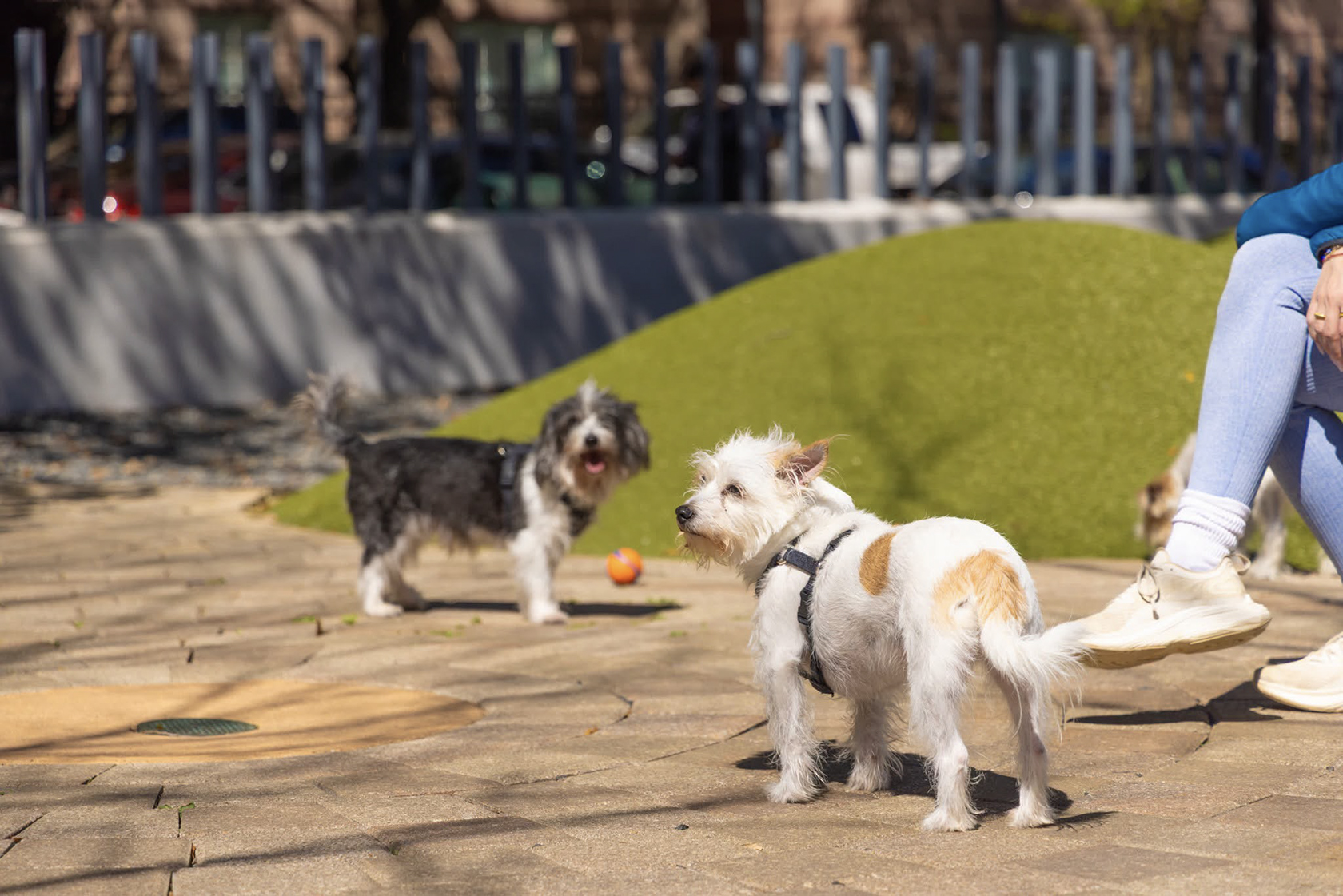
Stage Two: Parks and Trails Once Fully Vaccinated
Now the city opens up. These are the places that work well for a young dog, with notes on what makes each suitable.
Buffalo Bayou Park
The long paved trail system along the bayou is probably the best general-purpose option for a young dog in Houston. Paved surfaces, a lot of shade in stretches, water fountains along the route, and a wide enough path that you can create distance from other dogs when you need to.
Johnny Steele Dog Park sits within Buffalo Bayou Park and is one of the better-designed off-leash areas in the city, with separate small and large dog sections and a dog pond. The separate small-dog area matters for a young or small puppy, since an enthusiastic large dog is a genuine risk to a ten-pound puppy regardless of intent.
Memorial Park
Enormous, and the paved loops and trails give you plenty of options. The surfaced trails are better for a puppy than the softer running paths, both for paw comfort and because a paved route is easier to keep clean. Shade is good in places and nonexistent in others, so plan your route.
Terry Hershey Park
A long paved trail along the bayou on the west side, generally quieter than the central parks and well shaded in long stretches. The quiet is the appeal for a puppy who is still learning to handle distraction. Good for building up walking distance without a crowd.
Hermann Park
Leashed dogs are welcome on much of the grounds, and the mix of paved paths, open lawns and people makes it a strong socialization environment. The volume of foot traffic is the point: a puppy who learns to walk calmly past strollers, cyclists and crowds here will handle anything.
Levy Park
Smaller and more contained, with a dog run and a lot of shade structures. The scale makes it less overwhelming than the big parks, which suits a first off-leash outing better than a sprawling bark park does.
Discovery Green
Downtown, leashed, and heavy on people and activity. Not a place for exercise so much as a place for exposure. Short visits work better than long ones.
Millie Bush Bark Park
Inside George Bush Park, and one of the largest and best-known off-leash parks in the region, with ponds and separate areas by dog size. It is excellent, and it is busy. Save it for a confident, fully vaccinated dog with reliable recall rather than making it a first off-leash experience.
Danny Jackson Family Bark Park
Closer in, smaller, with separate small and large dog sections. A reasonable middle option between a quiet park and the scale of Millie Bush.
Ervan Chew Park
A neighborhood park with a dog run, small and generally relaxed. Good for a low-key first visit to an off-leash space.
White Oak Bayou Greenway
Another paved bayou trail, useful for distance walking once your puppy can handle it. Shade varies by segment.
The Heat: Houston’s Real Constraint
This is the section that matters more than any list of parks.
From roughly May through September, and often into October, Houston heat and humidity make daytime outings genuinely unsafe for a puppy. The air temperature understates the problem, because humidity interferes with a dog’s ability to cool itself by panting, and because the ground is far hotter than the air.
Pavement temperature. On a 90°F day, asphalt in direct sun commonly exceeds 140°F, which causes paw pad burns within about a minute of contact. The test: press the back of your hand flat on the surface and hold it. If you cannot manage seven seconds comfortably, your puppy cannot walk on it.
Workable hours in summer. Before 8 a.m. and after 8 p.m. Those are the windows. Midday walks in July are not a judgment call, they are simply off the table.
Signs of overheating to turn around for immediately: heavy or frantic panting, excessive drooling, bright red gums or tongue, stumbling or weakness, vomiting, or disorientation. Move to shade or air conditioning, offer small amounts of cool water, and contact a veterinarian promptly. Heat injury in dogs escalates fast.
Flat-faced breeds including French Bulldogs, Pugs, Bulldogs, Boston Terriers and Shih Tzus have substantially reduced heat tolerance and should have far shorter outings. For these breeds in a Houston summer, indoor enrichment should be the default and outdoor time the exception.
Winter is a different story and genuinely pleasant. November through March is the best season for building up a young dog’s walking habits here, which makes late autumn an excellent time to be starting out.
Puppy Outing Planner
| Stage | Age | Where to go | Avoid |
| Carried exposure | 8 to 12 weeks | Carried outings, car rides, your own yard | All public ground |
| Early walks | 12 to 16 weeks | Quiet sidewalks, puppy class, known yards | Dog parks, busy park lawns |
| First public parks | 16 to 18 weeks | Paved trails, leashed park paths | Crowded off-leash parks |
| Small off-leash | 18 weeks plus | Small dog sections, neighborhood dog runs | Large busy bark parks |
| Full access | 5 to 6 months | Everything, with recall established | Nothing, with supervision |
The jump people rush is the last one. A puppy with unreliable recall in a large off-leash park is a puppy you cannot retrieve when something goes wrong, and something going wrong in a busy bark park happens faster than you can cross it.
What to Bring
- Water and a collapsible bowl, every single time, regardless of season
- Waste bags, more than you think you need
- A standard six-foot leash, not a retractable one
- A harness rather than a collar for the leash attachment, especially for small breeds
- High-value treats for recall practice and for rewarding calm behavior around distraction
- A towel for the car
- ID tag on the collar, with current information
Dog-Friendly Patios
Houston has a lot of them, and a young puppy on a patio is an excellent training exercise once vaccinations are complete. The Heights, Montrose, Midtown and EaDo all have multiple options.
Two notes. First, verify in advance, because policies change and a wasted trip with a puppy in the car is nobody’s favorite afternoon. Second, a patio is a settle exercise rather than an outing. Your puppy should spend most of the visit lying on a mat under the table, which is a skill worth practicing at home first. A puppy who has never learned to settle will spend an hour pulling toward every passing dog, and nobody enjoys that.
Beyond the City
Once your puppy is grown and reliably recall-trained, the trails east and north of Houston open up considerably. Hiking With Your Dog: A Comprehensive Guide covers conditioning, water planning and trail etiquette, all of which matter more in this climate than in most. Build up gradually rather than attempting a real trail with a six-month-old.
If you are still deciding on a breed and weighing how it will handle Houston specifically, Most Popular Dog Breeds in Texas is worth a look, since heat tolerance varies enormously between breeds and it is a bigger factor here than almost anywhere else in the country.
Conclusion
A useful guide to dog friendly Houston for a new puppy owner looks less like a list of parks and more like a sequence. Carried outings and puppy class before vaccinations finish. Paved trails and leashed park paths at sixteen to eighteen weeks. Small, quiet dog runs before the big bark parks. Full access once recall is genuinely reliable.
And through all of it, the heat decides the schedule. Before eight in the morning and after eight at night from May through September, with the back-of-the-hand test on the pavement every time. Winter in Houston, which is right now, is the easiest and best season to be building these habits, so this is a good month to start.
Bringing a puppy home in Houston? The team at Pet City Houston can tell you where your puppy is in their vaccination series and what that means for the next few weeks of outings, which is the question that determines everything else. Come visit us, meet the puppies, and bring your questions.
Frequently Asked Questions
When can I take my puppy to a dog park in Houston?
Generally once the full vaccination series is complete plus one to two weeks, which puts most puppies at around sixteen to eighteen weeks old. Before that, dog park ground carries real risk from parvovirus and other diseases that persist in soil. Even after that point, start with a small quiet dog run or a small-dog section rather than a large busy bark park, and confirm the timing with your veterinarian.
Where can I take a puppy before vaccinations are finished?
Carry them. Carried outings through quiet shopping areas, short car rides, your own yard, a trusted friend’s yard with known vaccinated dogs, and well-run puppy classes that require proof of first vaccinations are all appropriate. Hard surfaces like quiet residential sidewalks carry less risk than grass, though check with your veterinarian first. The goal is exposure without paw contact on ground where unknown dogs congregate.
What time of day is safe to walk a puppy in Houston summer?
Before 8 a.m. and after 8 p.m. from roughly May through September. Midday walks are not advisable regardless of distance, because asphalt in direct sun on a 90°F day commonly exceeds 140°F and causes paw burns within about a minute. Use the back-of-the-hand test: if you cannot hold your hand flat on the surface for seven seconds, it is too hot.
Which Houston parks are best for a young puppy?
Once fully vaccinated, the paved bayou trails are the strongest options: Buffalo Bayou Park, Terry Hershey Park and White Oak Bayou Greenway all offer surfaced paths, reasonable shade in stretches, and room to create distance from other dogs. Hermann Park is excellent for socialization because of the foot traffic. Save the large off-leash parks for a confident dog with reliable recall.
Are there dog-friendly patios in Houston?
Many, particularly in the Heights, Montrose, Midtown and EaDo. Verify the current policy before you go, since these change. Treat a patio visit as a settle exercise rather than an outing: practice having your puppy lie calmly on a mat at home first, because a puppy who has not learned to settle will spend the whole visit pulling toward passing dogs.
How long can a puppy walk in Houston weather?
Use roughly five minutes of structured walking per month of age, twice daily, as the joint-protection baseline. In Houston heat, shorten that further and shift it to the cooler hours. A four-month-old might do fifteen to twenty minutes in November and considerably less in July, with indoor enrichment filling the gap during the hottest months.
What are the signs my puppy is overheating?
Heavy or frantic panting, excessive drooling, bright red gums or tongue, stumbling or weakness, vomiting, and disorientation. Move to shade or air conditioning immediately, offer small amounts of cool water, and contact a veterinarian promptly, since heat injury escalates quickly. Flat-faced breeds including French Bulldogs, Pugs and Bulldogs are at substantially higher risk and need much shorter outings.
Should I use a leash or let my puppy off-leash at the park?
Leashed everywhere except designated off-leash areas, which is both the rule in Houston parks and the sensible choice for a young dog. Off-leash freedom requires reliable recall, and a puppy under five or six months generally does not have it. Practice recall on a long line in a quiet space before trusting it in an open park.