
Every December, someone says the same thing: puppies love the holidays, all those people to play with, all that attention. It sounds sweet, and it is mostly wrong. A puppy who has been home for two or three weeks does not experience your party as a celebration. She experiences it as the day every predictable thing in her small world changed at once: new smells, new voices, furniture moved, her feeding spot relocated, and strangers reaching for her from above.
What actually keeps a puppy calm through the season is not more socializing. It is a routine that refuses to move. Feed at the same times, potty on the same schedule, and protect naps like appointments. A puppy under four months needs 18 to 20 hours of sleep a day, and a tired puppy is the one who mouths hands, barks at guests, and unravels by 8 p.m. The puppy holiday tips that matter are boring on purpose: same bowl, same door, same bedtime, while everything else in the house gets festive.
This guide walks through the four things that decide how your puppy handles guests: an unbroken daily routine, a retreat space set up before anyone arrives, clear greeting rules at the door, and a real energy burn earlier in the day. Houston gives you one advantage most of the country does not have in December, and we will use it: mild weather that allows a proper walk on party day.
Start With the Routine, Not the Decorations
Write your puppy’s normal day down before the first guest is invited: wake time, first potty, breakfast, midday feed if she is on three meals, nap blocks, dinner, last potty, bedtime. For a three-month-old, that usually means potty breaks every 1 to 2 hours while awake, meals at roughly 7 a.m., 1 p.m. and 6 p.m., and crate naps after every 45 to 60 minutes of activity. That sheet goes on the fridge, and the party gets planned around it, not the other way around.
Guests can adapt to a schedule. A puppy cannot. If dinner for the humans moves to 7 p.m., the puppy still eats at 6. If the living room becomes the party room, her potty route to the back door stays clear of coolers, gift bags and extra chairs. Small consistencies like these are what a young dog reads as safety. Keep the same cue words, the same leash, the same treat for a successful outdoor potty, and the same blanket in the crate, unwashed, so it smells like her.
Do this: set phone alarms for the puppy’s meals and last potty on party day. It sounds excessive until the third conversation runs long and dinner for the dog quietly becomes 9 p.m., followed by a 2 a.m. accident that everyone blames on the puppy instead of the schedule.
Set Up a Retreat Before Anyone Arrives
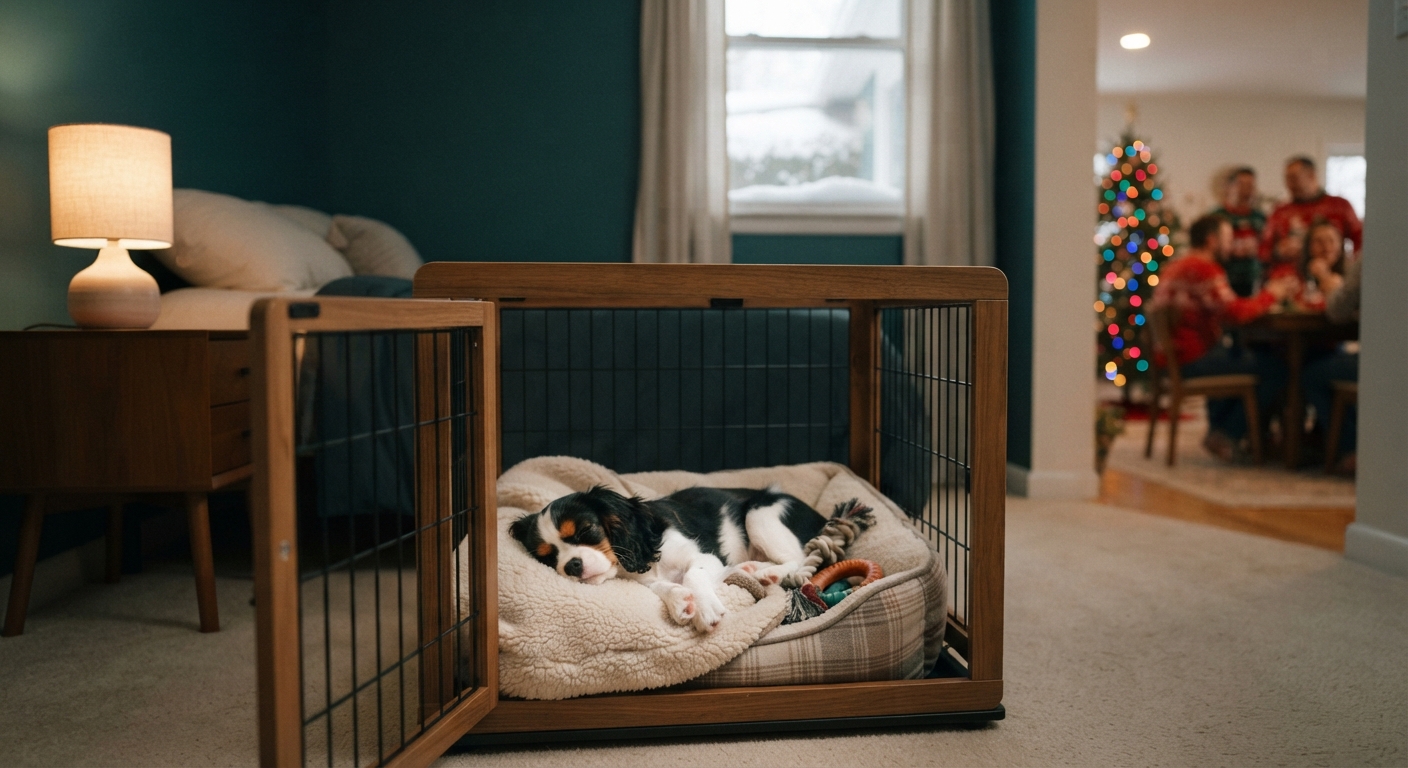
Every puppy at a gathering needs an exit. Set up a crate or a small pen in a quiet room away from the front door and the kitchen, ideally a bedroom with the door mostly closed. Inside goes the crate with its usual blanket, one long-lasting chew, a water bowl, and something that makes low, steady sound, like a radio on a talk station at low volume. Introduce this room three or four days before the event, with short practice stays of 15 to 20 minutes and a treat each time, so the retreat reads as her place and not as exile.
Apartment and small-space version
If you are in one of Houston’s many apartment communities, the retreat may be a crate in the corner of your bedroom with a sheet draped over three sides to cut visual stimulation. The principles are identical, and our guide to apartment living with puppies covers the noise and neighbor side of small-space puppy life in more detail. What matters is distance from the doorbell and a door you can close.
Retreat time is not a failure or a timeout. Plan it in blocks: the puppy joins the gathering for 20 to 30 minutes of supervised social time, then rests for an hour or more, whether or not she looks tired. Puppies rarely choose rest while a party is available to them, in the same way a toddler will never vote for a nap. You decide for her, on the schedule, before the over-arousal starts. Watch for the early signs: yawning, looking away from people, lip licking, and a sudden second wind of frantic zooming. That second wind is exhaustion, not energy, and it is your signal.
Door Rules: How Guests Meet the Puppy
Most holiday puppy stress starts in the first ninety seconds: doorbell, door swings open, three people crouch and reach at once while a fourth scoops the puppy up. Set the rules before the first arrival and say them in the group text, not at the door. Guests enter, ignore the puppy for the first five minutes, let her approach and sniff, and scratch her chest rather than patting the top of her head. One greeter at a time. Nobody picks her up without asking you first, and children sit on the floor and let the puppy come to them.
Put the puppy on a leash for arrivals and departures, even indoors. The two most dangerous moments of a holiday gathering are the open front door during arrivals and the open front door during goodbyes, when nobody is watching the gap at ankle height. A house leash, a baby gate at the entry, or simply holding the puppy during door traffic closes that risk completely. Our roundup of ways to make the holidays safer for pets covers the food, decor and plant hazards that sit alongside the door problem, and it is worth ten minutes before your first event of the season.
Also assign one adult as the puppy person for each event. Not a child, and not the host who is also running an oven. That person’s job is bathroom breaks on schedule, watching body language, and making the retreat call. Rotate the job between events if your family hosts more than once.
Burn the Energy Before the Doorbell
Here is where Houston December earns its keep. While much of the country is managing puppies around ice and early darkness, Houston party days usually sit in the 50s and 60s, cool enough for a real walk and mild enough for a young puppy to enjoy it. Use that. A 25 to 30 minute walk plus ten minutes of sniff-heavy play in the yard, finished about an hour before guests arrive, takes the edge off better than any calming product on the shelf. Follow the age rule for structured exercise, about 5 minutes per month of age, twice a day, and let sniffing do the rest of the work: ten minutes of nose-led wandering tires a puppy’s brain more than ten minutes of marching.
Feed dinner after the walk and before arrivals, then take the final pre-party potty right as the first car pulls in. A puppy who arrives at the party fed, emptied, exercised and due for a nap within the hour is a puppy who can be charming for her 20-minute appearance and then sleep through the loud part. Skip the temptation to keep her up for the whole evening because she is being good. Good behavior borrowed against sleep always gets repaid, usually at midnight.
A Party-Day Schedule That Protects the Puppy
Here is a sample day for a three to four-month-old puppy with guests arriving at 5 p.m. Adjust the clock, but keep the order: exercise before arrivals, social time in short blocks, retreat before exhaustion, last potty at the usual time. Notice how little of the day is actually party. That ratio, roughly one hour of guests to three hours of normal puppy life, is the whole secret, and it is why collecting a handful of proven puppy holiday tips before the season starts beats improvising on the day.
| Time | Puppy plan |
| 7:00 a.m. | Wake, potty, breakfast, short play session |
| 9:00 a.m. | Crate nap, 1.5 to 2 hours, radio on low |
| 11:30 a.m. | Potty, ten minutes of training games, midday feed |
| 3:30 p.m. | Main walk, 25 to 30 minutes, plus yard sniffing |
| 4:30 p.m. | Dinner, final pre-party potty, settle in retreat |
| 5:00 p.m. | Guests arrive; puppy greets on leash, 20 minutes max |
| 6:30 p.m. | Retreat block with a chew while humans eat |
| 8:30 p.m. | Short second appearance if calm, then bed routine |
| 10:00 p.m. | Last potty at the usual spot, bed for the night |
Conclusion
A calm holiday puppy is not a lucky accident or a special temperament. She is a puppy whose meals, potty breaks and naps happened on time while the humans celebrated around the edges of her routine. Give her a retreat she already trusts, rules your guests hear before they arrive, a real walk in the mild Houston afternoon, and social time measured in minutes instead of hours. Do those four things and the puppy holiday tips in this guide stop being advice and start being just how your house runs in December.
If you are choosing a puppy now with the holiday season ahead, the team at Pet City Houston can help you match breed, size and energy level to the home the puppy will actually live in, guests and all. Browse our current puppy breeds at Pet City Houston and come in to talk through timing, because bringing a puppy home the week of a big gathering deserves a plan, and we are happy to help you build one.
Frequently Asked Questions
How long can my puppy be out with guests at a time?
Keep social blocks to 20 to 30 minutes for puppies under four months, followed by at least an hour of retreat rest. Puppies that young need 18 to 20 hours of sleep a day, and most holiday meltdowns happen in the second overtired hour, not the first.
Can I let guests give my puppy treats?
Yes, with rules. Guests hand over only the puppy’s own treats or a few pieces of her kibble, given flat-palmed while she has all four paws on the floor. No table food, no exceptions for just a little bit, and keep the total to a small handful across the whole event so dinner still happens.
What do I do if my puppy barks at visitors?
Do not scold or comfort-dramatically; both feed the behavior. Increase distance, let her watch guests from across the room on leash, and reward quiet glances with a treat. If barking escalates after two or three minutes, that is retreat time, not more practice.
Is a crate cruel during a party?
No, provided the crate was introduced positively days earlier and the puppy has been exercised, fed and taken out first. Most puppies sleep deeply and gratefully through noise once they trust the space. A crate used as a sudden banishment mid-party is the version to avoid.
Should I skip the gathering entirely with a brand-new puppy?
If the puppy has been home less than a week and the event is large, loud or far away, skipping is a legitimate and often wise choice. Small, short, quiet visits at your own home are the better first exposure, and there will be many more holidays.
How does Houston weather change holiday puppy plans?
December in Houston usually means highs in the 60s, which allows a proper afternoon walk before guests arrive, something owners in colder states cannot rely on. Watch for the occasional cold front or all-day rain instead, and have an indoor play and training plan as the backup energy burn.